

Go to content

History & Heritage - Killeigh Parish

Skip menu
This Website was last updated:- .
Skip menu
Skip menu

History & Heritage

Roads are marked Blue

Railway is
Yellow-- - - -

Canal is in BLUE

Townslands outlined in black

To mark the 50th Anniversary of Killeigh Church Opening in 1971.
In 1808 the landlord, Rt. Hon Edward Earl Digby gave a site in Killeigh to ‘his Catholic tenantry for their Religious use only’. Within a few years the ‘old church’ in Killeigh was built. Before 1808, during the time of the Penal Laws when Catholics were not allowed to have schools, churches or priests, the faithful people met secretly out of sight in Mass-houses and at Mass-rocks. The last such Mass-house in the Killeigh area was on land owned by the Kelly Family on the Finter Road. The family have respected that site ever since, leaving it unploughed, untilled and unreclaimed. They have allowed nature take its course on that ‘Sacred Place’.
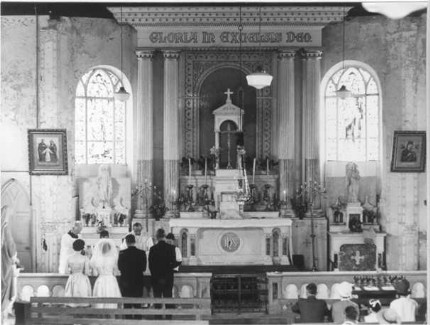
           The first church after Penal Times in the parish was in Killeigh. It was cruciform in shaped, with three galleries maximising the capacity in a limited space. Inevitably over time repairs, alterations, and upgrading took place, such as:-
The church was reroofed in 1898, and the walls were raised by 12”.
The original building did not have a main door at the end, but one half way along the side wall. It was probably given its main door and entrance hall when reroofing.
The High Altar was added in 1941, and was blessed and consecrated on the 12th November 1941,  
just 30 years before the new church was opened.

In 1963 the Parish Priest, Fr Dan Kennedy, and his parishioners became concerned for people’s safety because of major cracks in walls, poor lighting and the lack of any heating system. As a result of this, Mr Patrick J. Sheahan, Architect, of 47 O’Connell Street Limerick was consulted. He examined the church in detail on the 2nd Oct 1963, and then drew up an assessment of the whole building. It is a 12 page document dated 8th November 1963. Having listed in detail every aspect of the building, he then focused on the many changes which needed to be made. Initially, he drew up plans to repair and enhance the existing building. He estimated that the plan would cost between IR£27,000 and IR£30,000. According to this plan, the original stone walls would be retained without foundations or damp course. At this time, it was discovered that the wall on the village side of that church was 4” off plumb, leaning outwards, and the other side was 1” out.

The then bishop’s advice about the proposed reconstruction was sought in November 1963. Bishop Tom Keogh replied on 5th Dec 1963, indicating his preference for a new building. Some locals were also consulted. The dominant opinion was in favour of a new building on a new site. Thanks to the Mathews Family, a site was gifted to the parish. The Architect then drew up his plans for a new church, modelled on the style of churches built before Vatican II. He estimated that it would cost £42,000. In his plan, the High Altar would be 100 ft. from the entrance.
This was the architect’s first presentation. Bishop Tom Keogh retired on 25th September 1967 and Bishop Patrick Lennon was his successor. He was strongly of the opinion that a new church should be built according to the requirements of the Liturgical reform after the Vatican Council (1962 -65.) Accordingly, a 2nd edition of plans for the new church were produced which were for a similarly large building. After further consultation with Bishop Lennon, the plans were revised again and these final plans gave us the building we have today.

In a letter to the Parish Priest, Fr Dan Kennedy, dated 30th Nov 1969, Bishop Lennon specifically detailed where the Altar, the Ambo, the Tabernacle and the Presider’s Chair should be placed. He specified that the priest would be celebrating Mass facing his congregation. The original estimate for this plan in June 1969 was £54,000. The final figure was £649.1s.6d more. Not bad!!
In the old church, as was the custom at the time, the priest stood at the head of his people, with them looking up to God. While he read the prayer of the Mass in Latin, people prayed privately. In a sense the priest was praying on their behalf. The present layout of the altar, in keeping with the liturgical reforms of Vatican Two, with the priest facing the people, enables a far greater participation by the congregation, gathered as one family around the ‘Table of the Lord’ and praying together in the language spoken by the people. The priest still leads his people in prayer, giving praise and honour to God.
The present church in Killeigh was opened on 12th September 1971. We had begun to discuss and plan for the celebration of the 50th Anniversary of the opening of St Patrick’s Church before the pandemic struck in 2020.                                                                                            John Stapleton P.P. Killeigh, Christmas 2021


St. Patrick's, Killeigh


The 'Old Church'
as it was inside.
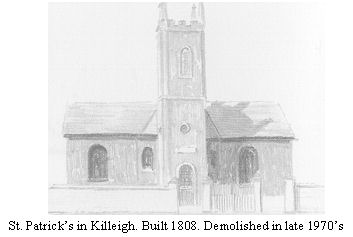


Pencil drawing of the above
'Old Church' of Killeigh.

The outline of the building is still visable in the 'Old Cemetery'
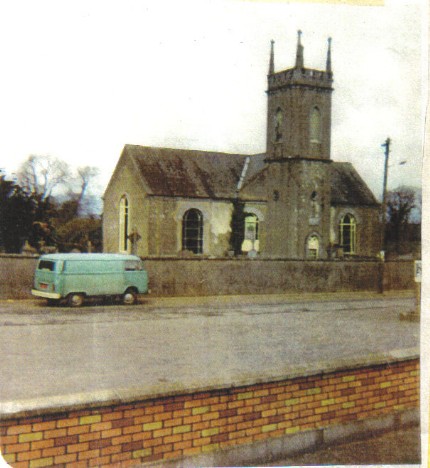
The 'Old Church' as it was before demolition
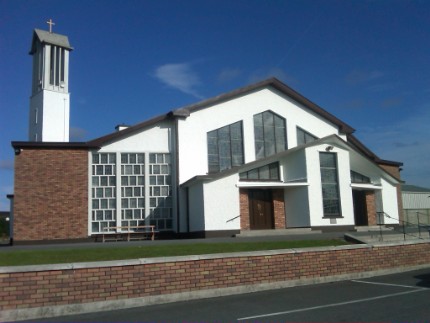
St Patricks Killeigh
Date of church: 1971
Architect: Patrick J. Shehan
Builder: J. J. Kilmartin
Building pastor:
Fr. Daniel Kennedy PP.
Seating: 600
Cost.. £70,000

Killeigh
Cill achaidh, church of the field; earlier Acha-droma-fada, the field of the long ridge. 'Cill' was Prefixed after St. Senchell had his church in the area.
The long ridge is the predominant feature of the extensive flat countryside.
At the beginning of the 6th century, St. Senchell (the elder), converted by St. Patrick, founded his monastery at Killeigh. Many ancient local chieftains are buried in the monastery's graveyard. O'Conor Faly built a Franciscan monastery there in 1393. This was on the road to Tullamore. Stone from its walls was later used locally in buildings. Buried here is an early bishop of Kildare, Finn Mac Tiarchan, who died in 1160 AD.
A convent of Augustinian nuns also existed in Killeigh. Margaret O'Carroll, mother of a member of the order, Finola, conducted two large festivals on the feast day of St. Senchell, one in Killeigh and one in Rathangan, Co. Kildare.
The waters of Killeigh’s seven blessed wells are said to have curative powers.
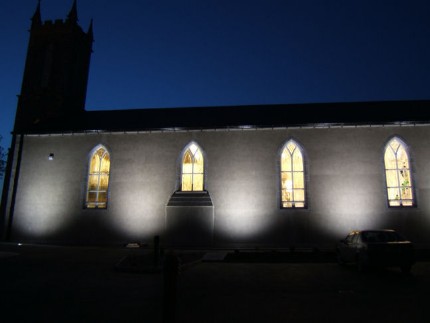
St. Joseph's, Ballinagar
Date of church: 1837
Style: gothic, barn_type
Building pastor:
Fr. James Kinsella PP
Burned 12 Feb 2004
Re-opened 23 April 2006


Ballinagar
(Beal Átha na gCarr, The ford mouth or ford of the cars).
The fordable crossing points of rivers were known to the very earliest colonists, and distinguished by name. This ford is believed to have been near Ballinagar, on the road to Geashill.
A thatched chapel served the Ballinagar area in Penal times and the present church was built over it. The church was improved over the years, with flooring, dry lining, re-roofing, altar rails, marble altars, and in 2002 had a new sanctuary layout, according to liturgical requirements of the Vatican Council. All was destroyed by fire on Thurs. 12th Feb.  2004.  McCarthy O’Hora of Portlaoise designed the restored church we have today.
It was blessed by Bishop Jim Moriarty, on 23rd April 2006.
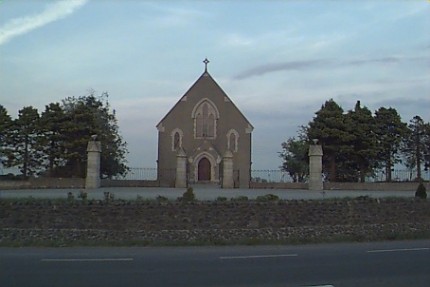
St. Mary's, Raheen
Date of church: 1935
Style: rectangular
Architect: P. J. Foley, Dublin
Building pastor:
Fr. Luke Byrne P.P.
Cost £10,000  

Raheen
(Little rath, fort). Raheen castle stood in this townland. The area of Geashill was the scene of a fierce battle c.500 B.C. The ancient annals record the existence of many mounds in the area where Heber and other chiefs were buried. In the 1800's human bones were unearthed in this locality in large quantities.
St. Mary's replaced an older chapel situated on the opposite side of the road. The cost of the building was kept low by the voluntary assistance of local people in drawing materials, etc. The building project was initiated by Fr Luke Byrne PP His tombstone is to the left of the entrance, near the bell. When the church opened in March 1935, the PP. was Fr. Michael P. Kennedy. Bishop Matthew Cullen officiated at the opening ceremony.
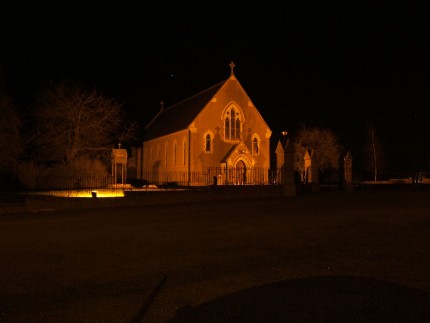


St Mary's Raheen
New floodlighting Spring 2009

HISTORY OF KILLEIGH:

Compiled by the late Fr. Dan Kennedy, Parish Priest of Killeigh  from 1955.  to 1977, for a series of newsletters addressed to emigrants from the parish, as a means of keeping them in contact with home.
This project was carried out during his retirement. [1977 – 1998 ]


Click this link to a pdf version.  

SOME OF OUR HERITAGE

Killeigh Abbey

The 'Blessed Wells' of Killeigh

Registered Charity, Number 20015848
Back to content